
W ith the price of Wholesale Energy currently an almost daily news story it’s worth remembering that in September 2021 almost 60% of your energy bill was made up of non-commodity costs.
Some of these non-commodity costs will be itemised as additional charges on your bill but the majority are incorporated rather than hidden into both the unit rate and standing charge you pay, the exact incorporation of which will vary depending on your supplier.

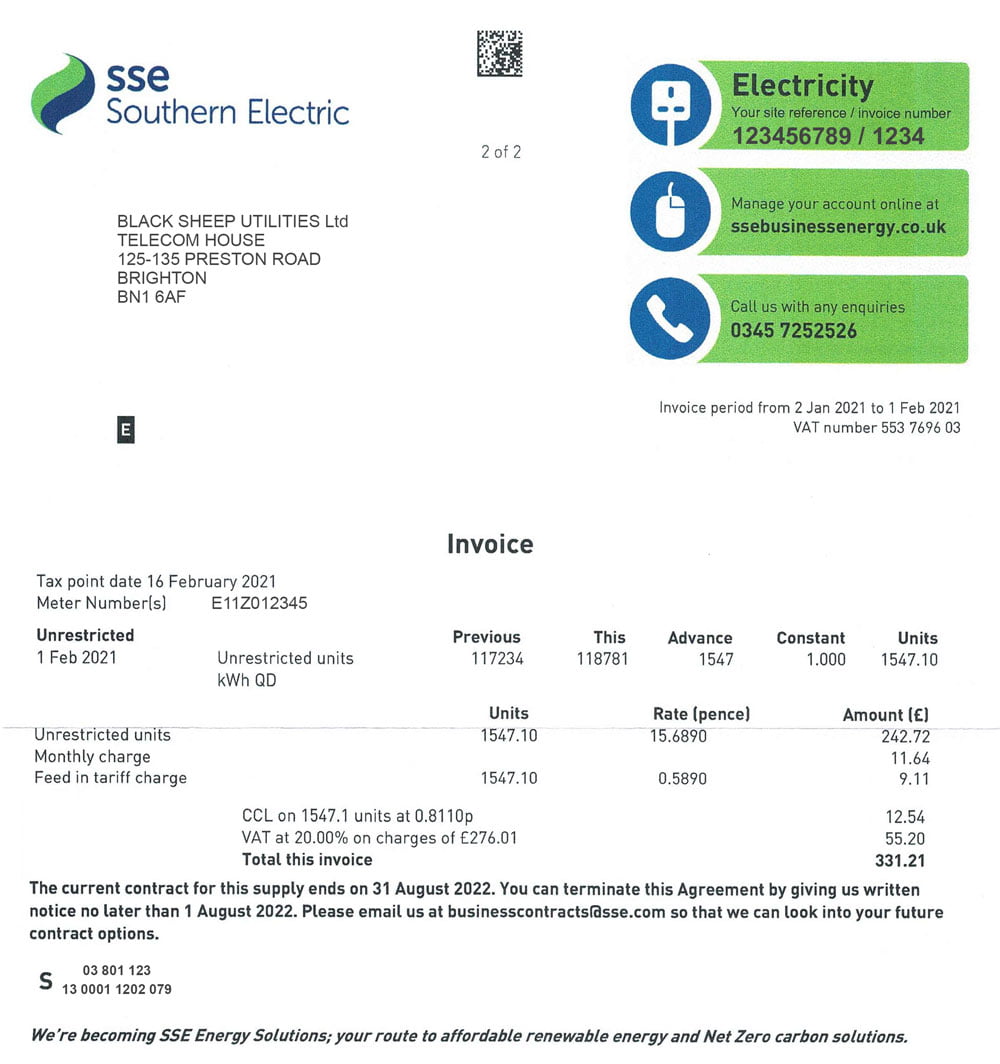
What can I see on my bill?
Usually, the only non-commodity cost you will see itemised on your bill will be the Climate Change Levy (CCL) but if you’re an SSE customer, the Feed in Tariff (FiT) will also be itemised.
The only exception to this is for businesses on ‘pass through’ or ‘Raw Power’ contracts which have all non-commodity costs itemised on their bills. Although itemised the actual costs will be forecasted which are then later reconciled.
For the majority of business customers all other non-commodity costs will be wrapped up in your unit rate and standing charge you pay.
Use of System Costs
Delivering energy to customers requires infrastructure and management which are divided into four categories that make up the non-commodity costs you pay.
These are the ‘Transmission Network Use of System’ (TNUoS), the ‘Balance Services Use of System’ (BSUoS), the ‘Distribution Use of System’ (DUoS) and Loss charges.
Renewable Subsidies
Currently, there are three renewable subsidies included in your bill as non-commodity costs – ‘Contract for Difference’ (CFD), ‘Renewable Obligation’ (RO) and ‘Feed-in Tariff’ (FiT).
Taxes and support levies
There are several additional taxes and support levies which are also included in your non-commodity costs. These include the ‘Climate Change Levy’ (CCL), ‘Capacity Market’ (CM) and ‘Assistance for Areas with High Electricity Distribution Costs’ (AAHEDC).
VAT although an additional tax, where applicable, isn’t normally included as a non-commodity cost as it’s a general taxation mechanism.
Catalyst for change
The current energy crisis has seen the wholesale cost of energy soar which has, in turn, resulted in a change to the proportional costs of your energy bills. In September 2021 roughly 60% of bills were made up of non-commodity costs but the recent rise in wholesale energy prices has caused a shift in balance whilst also acting as a catalyst for non-commodity cost increases.
The energy crisis hasn’t just caused an increase in wholesale costs it, combined with other geopolitical factors, as well as climate change promises and obligations has led to a further drive towards self-sustainability which will require massive amounts of investment in infrastructure.
As the industry and government look for funding for this renewable self-sustainability it’s non-commodity costs that will be increased to deliver.
Whatever the future holds for wholesale energy costs, non-commodity costs are set to continue to rise with especially steep increases in the mid to near term.
Want more information about non-commodity costs?
If you’re not sure of the difference between your ‘TNUoS’ and your ‘CCL’, you are not alone. Check out our non-commodity FAQ section below for an overview of each of the different non-commodity costs.